The Terroir
Deep in the monsoon forests of Assam, only a fraction of Aquilaria trees ever form the dark, fragrant resin known as oud — a response to time, wound, and weather.
Mağazam
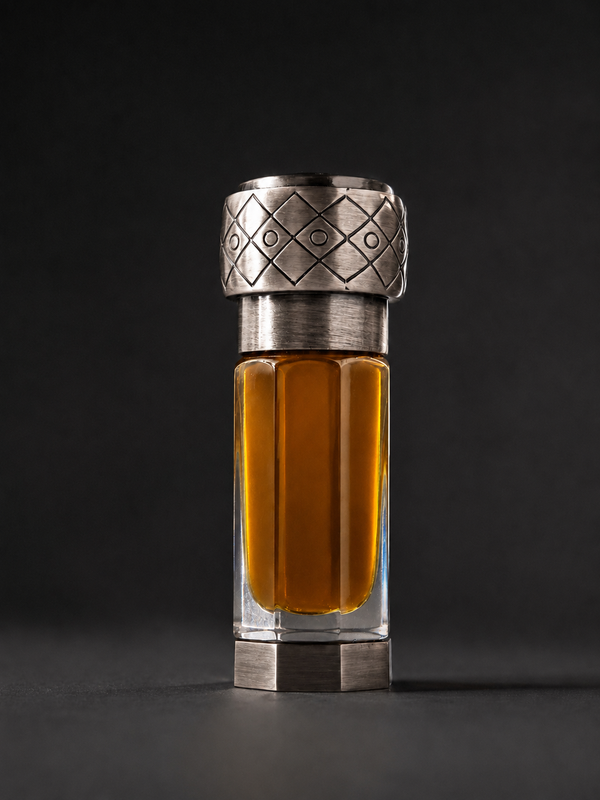
OUD HINDI — ASSAM 2016
80-Year-Old Tree · Fermented Special Production · 10 Years Matured
Some ouds tell the story of a geography. Others carry not only the soil but also time.
This special Oud Hindi was prepared by fermenting resinous wood obtained from an approximately 80-year-old Assam agarwood tree and distilled in 2016. The decades-long history of the tree, Assam's ancient fermentation tradition, and ten years after distillation all converge in the same oil.
This is not just an oud obtained from an old tree; it is a record of Assam that has been maturing for ten years, leaving its hasty and sharp edges behind.
The initial contact does not hide the dark side of old-school Hindi oud. Warm animal hide, dried herbs, damp earth, aged leather, and fermented tobacco… A controlled animalic note is distinctly felt; however, the sharp and scattered harshness that might be encountered in a young distillation is absent here. The passing years have rounded the edges of the opening, allowing time for the fermentation and wood to settle together.
After a while, the dark curtain parts.
Raw tobacco leaf, strong black tea, damp henna leaf, and fire-roasted spices emerge. Behind them lies a dim sweetness reminiscent of sour dried fruits, old wood, and a smokeless incense sensation. The resin is dark, warm, and dignified; it reveals itself layer by layer rather than all at once.
As it settles on the skin, the animalic character recedes into the skin. Dried herbs turn into warm tobacco, damp earth into dark resin, and sharp spices into a smoky woody warmth. The natural musk texture at the base makes the scent intimate and almost alive.
Sometimes an unopened wooden chest for years…
Sometimes dark earth wet after the rain…
Sometimes tobacco and incense smoke permeated into the skin…
This oud does not stay in one place. With each sniff, it reveals another detail.
The Mark Left by a Decade
Oud oil does not merely age over time; when rested under proper conditions, its harsh lines soften, its layers integrate, and the scent gains a more rounded structure. The value of Assam 2016 lies here: the wild power of fermentation has not been lost, but it has gained a dignified depth over time.
It is powerful; it does not shout.
It is animalic; it does not become crude.
It is dark; but it does not hide its details.
Olfactory Associations
Controlled animalic · Warm animal hide · Aged leather · Dried grass · Damp earth · Fermented tobacco · Black tea · Henna leaf · Roasted spices · Sour dried fruits · Smoky resin · Old wood · Incense · Natural musk
These expressions do not describe added notes but rather the olfactory associations that natural oud oil can evoke on the skin.
A Rare and One-Time Collection
It is not possible to replicate such a special raw material from an approximately 80-year-old tree with the same fermentation conditions and distillation character. The available quantity consists of the limited reserve remaining from the 2016 production.
This oud will not be reproduced.
There will be no more.
It will not be restocked once the last bottle is sold.
Therefore, Assam 2016 is not merely a regularly produced item but a rare collector's piece whose value increases with time. Not just for use, but for keeping, reopening years later, and remembering what a true old-school Hindi oud smells like…
Usage
Apply a tiny amount, taken with the tip of the oud stick, to the inside of your wrist. Allow it time for the fermented and animalic opening in the first few minutes to give way to tobacco, leather, tea, spices, and resinous wood.
This oil is not an oud to be hastily smelled and understood. Try it on a few different days; it will reveal another facet as the weather, your skin, and the amount used change.
When the last bottle reaches its owner, this oud will not merely be sold out; its story, which began in 2016, will be complete.

The Story
Some scents are made. This one was waited for — coaxed from resin-veined heartwood that took decades to ripen in silence.
Deep in the monsoon forests of Assam, only a fraction of Aquilaria trees ever form the dark, fragrant resin known as oud — a response to time, wound, and weather.

Harvested by hand from naturally infected heartwood, each fragment is graded by scent alone, the way it has been for generations.
Rested in glass for years beneath changing light, the oil softens and deepens into leather, honey and smoke.
“To wear oud is to carry a forest, a season, and a century on the skin.”
Questions
Apply a single drop to pulse points — wrist, neck, behind the ears. Concentrated oils bloom over minutes, so wear sparingly.
Pure oud oil is exceptionally long-lasting; expect 10–12 hours on skin and considerably longer on fabric.
Each order is hand-packed in a protective case and dispatched with tracked, insured delivery.